
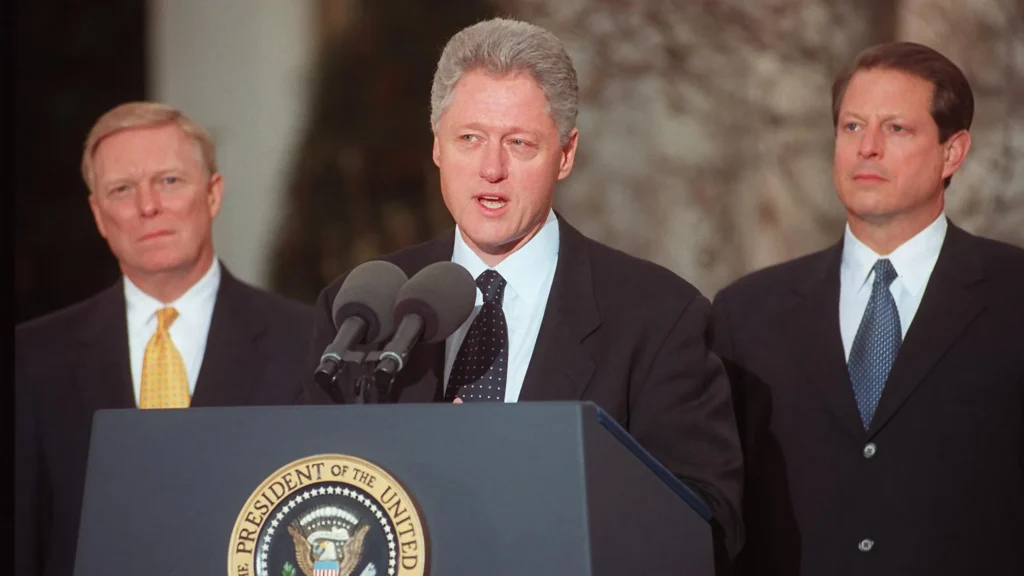
When Bill Clinton took office in 1993 following twelve years of Republican administrations, he enjoyed deep cultural rapport and overwhelming electoral support from African Americans—earning him the informal moniker “America’s first Black president” from novelist Toni Morrison in 1998. Across his two terms from 1993 to 2001, Clinton presided over a historic economic boom that lifted millions of Black families into the middle class and appointed a record number of African Americans to senior federal positions.
At the same time, his presidency became a source of fierce debate among Black scholars, activists, and civil rights leaders. Critics contend that major legislative compromises of the 1990s—most notably the 1994 Crime Bill and the 1996 welfare overhaul—accelerated mass incarceration and weakened the social safety net in ways that disproportionately harmed Black communities for decades.
Economic Boom, Employment and Homeownership Gains

One of the most widely praised aspects of Clinton’s presidency was the sustained economic expansion of the 1990s,paired with targeted policies aimed at low- and moderate-income workers. During his eight years in office, the Black unemployment rate fell from 14.2% in 1992 to a then-historic low of 7.0% in 2000, while Black median household income rose by more than 30% in inflation-adjusted terms and Black poverty rates dropped to their lowest recorded levels at the time.
Several policy initiatives contributed to these gains. Early in his first term, Clinton championed a major expansion of the Earned Income Tax Credit (EITC) alongside increases in the federal minimum wage, lifting millions of working families above the poverty line. His administration also strengthened enforcement of the Community Reinvestment Act (CRA) and expanded Federal Housing Administration (FHA) lending programs, helping push the Black homeownership rate from 42% in 1993 to over 47% by 2000. Additionally, Clinton established Empowerment Zones and Enterprise Communities, directing billions of dollars in tax incentives and grants to revitalize distressed urban neighborhoods.
Cabinet Diversity and Federal Representation

Clinton reshaped the leadership of the executive branch and the federal judiciary by appointing African Americans to unprecedented positions of authority. He named more Black cabinet secretaries than any president before him, including Ron Brown as the first African American Secretary of Commerce, Mike Espy as the first Black Secretary of Agriculture,Hazel O’Leary as the first Black Secretary of Energy, Jesse Brown as Secretary of Veterans Affairs, Alexis Herman as the first Black Secretary of Labor, and Rodney Slater as Secretary of Transportation.
In the federal courts, Clinton appointed 61 African American judges—more than all previous presidents combined at the time—significantly expanding diversity across district and appellate benches.
Civil Rights Initiatives and Global Engagement

Throughout his presidency, Clinton sought to address racial disparities through executive initiatives, public dialogue, and international outreach. In 1997, he launched One America in the 21st Century, the President’s Initiative on Race,establishing an advisory board to examine racial reconciliation, economic inequality, and civil rights enforcement. That same year, he issued a formal presidential apology on behalf of the U.S. government to the survivors and families of the Tuskegee Syphilis Study, acknowledging the ethical abuses inflicted upon Black men by federal health authorities between 1932 and 1972.
Clinton also placed heightened emphasis on U.S. relations with Africa. In 1998, he embarked on an extensive six-nation tour of sub-Saharan Africa—the most comprehensive visit by a sitting U.S. president—and later signed the African Growth and Opportunity Act (AGOA) in 2000 to expand trade and investment between the United States and eligible African nations.
The 1994 Crime Bill and Mass Incarceration

Despite strong economic metrics, Clinton’s criminal justice record remains his most heavily criticized legacy in Black America. In September 1994, responding to rising violent crime rates and political pressure to appear “tough on crime,” Clinton signed the Violent Crime Control and Law Enforcement Act.
While the legislation included the Violence Against Women Act, a federal assault weapons ban, and funding for community policing and crime prevention programs, it also authorized billions of dollars for state prison construction, incentivized states to adopt strict “truth-in-sentencing” laws requiring inmates to serve at least 85% of their sentences, and established federal “three-strikes” mandatory life sentences. Civil rights advocates and criminologists argue that these provisions fueled an explosion in the U.S. prison population and entrenched severe racial disparities in sentencing, disproportionately incarcerating Black men and destabilizing families. Clinton later acknowledged in 2015 that the bill had contributed to the crisis of over-incarceration.
Welfare Reform and Social Safety Net Cuts

A second major source of criticism stemmed from the Personal Responsibility and Work Opportunity Reconciliation Act of 1996, which fulfilled Clinton’s campaign pledge to “end welfare as we know it.” The law replaced the decades-old Aid to Families with Dependent Children (AFDC) entitlement program with Temporary Assistance for Needy Families (TANF), imposing strict five-year lifetime limits on federal cash assistance and stringent work requirements.
While supporters credited the law with reducing welfare rolls and encouraging workforce participation during a strong labor market, sociologists and anti-poverty researchers found that the overhaul dramatically increased deep poverty among single-mother households—disproportionately affecting Black women and children—when subsequent economic downturns hit.
A Defining Yet Polarized Era

Bill Clinton’s presidency left a complex imprint on Black America. For many, his eight years in office are remembered for historic job growth, rising incomes, expanded homeownership, and an administration whose leadership genuinely reflected the diversity of the nation. For others, those economic achievements cannot be separated from the punitive criminal justice and welfare policies signed on his watch—laws whose structural consequences continued to shape racial inequality well into the twenty-first century.