
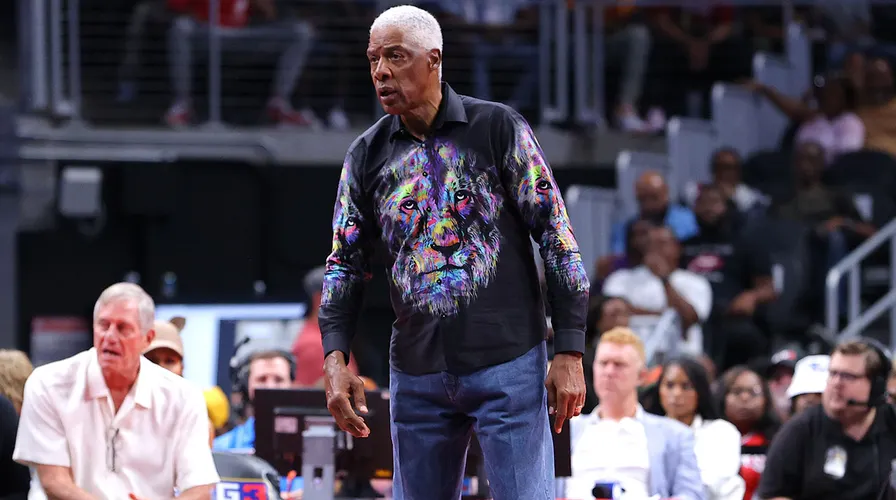
Basketball royalty, culture shifter and the ultimate blueprint for the airborne wing player, Julius “Dr. J” Erving joined Episode 1 of Season 2 of #WORDSWITHSCOOP for an exclusive, wide-ranging red carpet conversation.
Ahead of his iconic leap from the ABA to the NBA in 1976, Erving didn’t just bring elite athleticism—he revolutionized the global aesthetic of the sport, setting the foundation for signature sneaker line culture and above-the-rim dominance.
Back in 2017, while appearing on Scoop B Radio, Dr. J shared a perspective with me regarding the endless GOAT debate that still rings true today:
“I think people always make comparisons to people who are done. LeBron may play another six years, LeBron may play one year, we don’t really know. But I think it’s the fans’ argument, not the players’ argument. So I stay away from it. My all-time greatest player is Kareem Abdul-Jabbar. I think when you add up the numbers and add up the years, nobody has contributed more to NBA history or pro basketball history. It’s very subjective for you to say Michael or LeBron, who was better? Or who was the greatest, the GOAT—that is for the fans to argue about.”
Fast forward to 2026, and Dr. J’s philosophy on player evaluation remains unchanged. In this premiere red carpet interview, Erving reflects on his historic transition into the NBA, the championship brotherhood formed with Moses Malone during the Philadelphia 76ers’ legendary 1983 “Fo’ Fo’ Fo'” title run, and how the physical evolution of the league shifted the MVP dynamic from central big men to perimeter wings. He also candidly addresses his criteria for all-time player rankings, offering a unique perspective on player empowerment, legacy evaluation, and what Celtics star Jaylen Brown must do to sustain championship excellence.
Brandon “Scoop B” Robinson: When you made the leap from the ABA to the NBA in 1976, you didn’t just bring your game—you brought an entire elevated style of play. What was the biggest adjustment in getting NBA defenses and referees to adapt to your high-flying, above-the-rim game above the glass?
Julius “Dr. J” Erving: The big thing was I wasn’t alone; there were a lot of high-flyers. With my own individual style, I didn’t say a whole lot to the referees, and I didn’t complain. When they botched calls, I just kept moving. We evolved into a space where there was respect, right up until the time I became the MVP of the league. Once that happened, it was different.
Brandon “Scoop B” Robinson: After several tough Finals heartbreaks in Philadelphia, the ’83 “Fo’ Fo’ Fo'” title team finally brought it all home. How did adding Moses Malone change the team’s mental edge, and what did winning that NBA championship specifically mean for your legacy after dominating the ABA for years?
Julius “Dr. J” Erving: Moses started as an ABA player, too. I introduced him when I was with the Nets and he came out of high school before going to Utah. He was only 19 years old. Once he joined me in Philadelphia, it was like a reunion of sorts because we had always maintained a good relationship during the years he played for various teams, including the Rockets.
It was like a marriage made in heaven. He said, “It’s Doc’s team and it’s his show, but it might be a better show with me here.” I said, “Yeah, it better be a better show with you here.” From the first day of practice, we felt like we could beat anybody. In a seven-game series, the answer to whether we could win was yes. Our last series ended in a four-game sweep against the Los Angeles Lakers, so that prophecy came true—Moses saying “Fo’ Fo’ F.'”
Brandon “Scoop B” Robinson: You are widely credited with laying the groundwork for modern basketball culture, signature sneakers and the global airborne playing style. When you look at today’s game, where do you see your direct stylistic lineage most clearly, and how do you feel about how the art of the wing player has evolved?
Julius “Dr. J” Erving: The forwards and guards dominate the game now. It was a game dominated by centers in my day. As a matter of fact, the MVPs from 1966 to 1982 were all centers. Oscar Robertson was the one before, and I was the one during that period. Suddenly, it became guards and forwards who were the MVPs of the league, and that has been maintained today—though I think Wemby is going to change that.
Brandon “Scoop B” Robinson: You’ve been outspoken in the past about how modern stars building superteams through free agency impacts all-time rankings, specifically leaving LeBron off your top all-time list for that reason. As someone who joined a stacked 76ers roster in ’76 via a front-office deal, how do you balance executive team-building versus player empowerment when evaluating the legacy of a player as dominant as LeBron?
Julius “Dr. J” Erving: I usually talk about retired players being part of all-time teams, not current players. LeBron is not retired yet, so it’s hard to put him in his position until his career is over.
As for what’s going to happen in Philly, it’s going to be very exciting for the fans of Philadelphia and for LeBron. That particular team can set some records and win some championships, but they have to do it on the court, not with lip service.
Brandon “Scoop B” Robinson: As the ultimate blueprint for the explosive, above-the-rim wing player who anchors a franchise on both ends, what unique qualities do you see in Jaylen Brown’s game? What is the single biggest key for an elite wing like him to sustain championship-level output as his career progresses?
Julius “Dr. J” Erving: Health is the key issue. He’s generally played most of the games, even when some of his teammates have not. If he can stay healthy—he’s a young guy in the prime of his career—the sky’s the limit. He’s one of those guys who could be the guy. With that particular team, the open man needs to shoot the ball, and the playmakers need to find the open man.
Julius “Dr. J” Erving’s perspective bridges basketball’s classic era with the modern game, offering an unmatched masterclass in longevity, mindset and navigating greatness at the highest level. His insights on chemistry, accountability and the shift toward perimeter dominance underscore why his influence remains woven into the fabric of today’s NBA culture.
Season 2 of #WORDSWITHSCOOP starts off with a landmark interview that sets the tone for the stories, culture and pure basketball history ahead.
Season 2 of #WORDSWITHSCOOP starts off with a landmark interview that sets the tone for the stories, culture, and pure basketball history ahead. Catch full episodes and exclusive clips across all streaming platforms and social channels.