
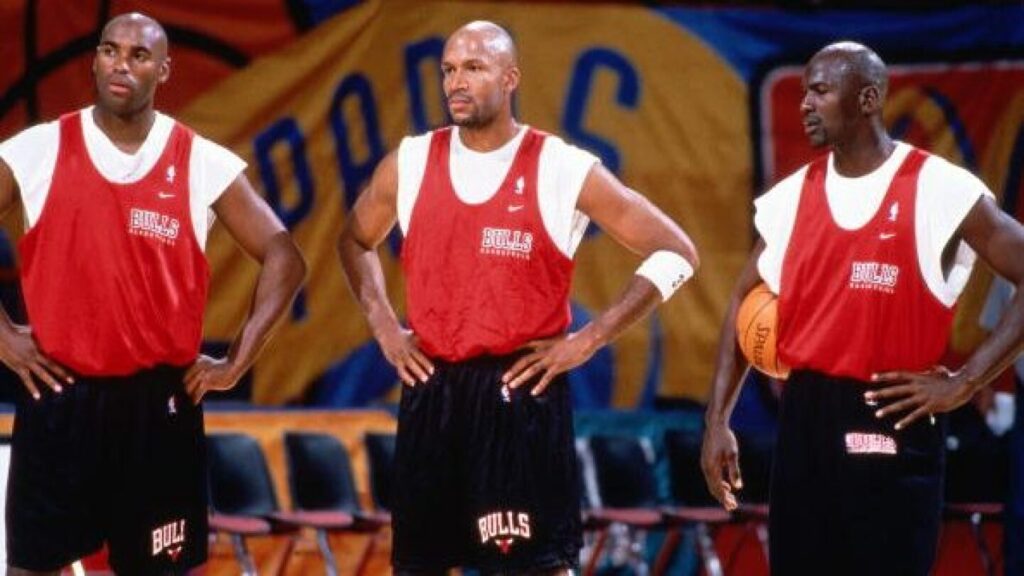
Winning an NBA championship is the pinnacle of a professional career, but earning one with the 1997-98 Chicago Bulls came with a tax: surviving the psychological and physical gauntlet of Michael Jordan. For Scott Burrell, that season was a masterclass in excellence disguised as a relentless trial by fire.
Burrell, a multi-sport phenom who was famously drafted in the first round of both the MLB and NBA drafts, joined a Bulls team already deep in the throes of a dynasty. What he found wasn’t just a locker room, but a high-pressure cooker where the greatest player to ever lace them up, Michael Jordan, and the eccentric genius of Dennis Rodman operated on a frequency few could match.
While history remembers the “Last Dance” as a triumphant finale, Burrell remembers it as the year he learned that being “good” was never enough. I sat down with the former Bull to discuss the torment of MJ, the mystery of Rodman, and why the “Triangle Offense” was more of a mental puzzle than a physical strategy.
The Q&A
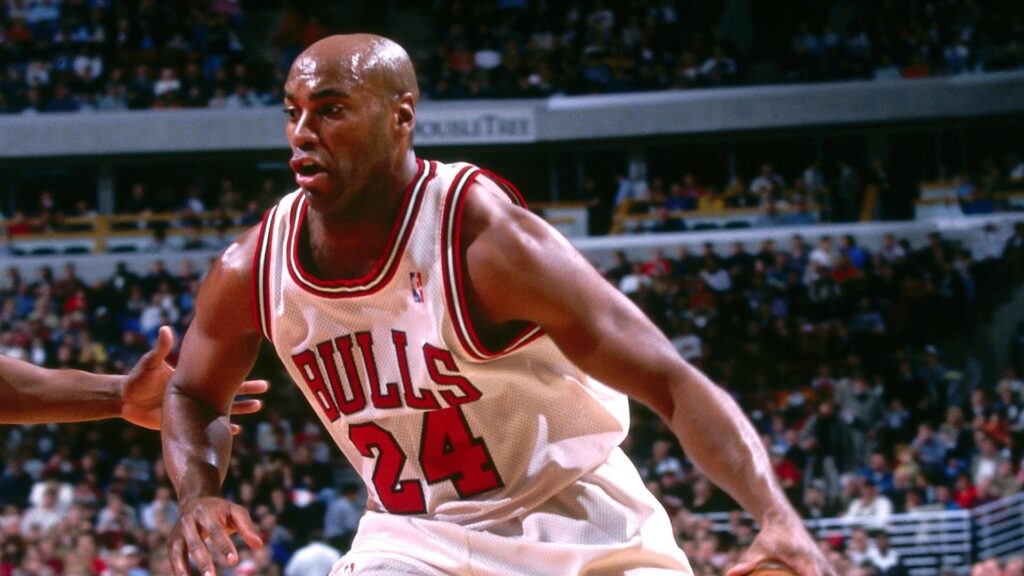
Brandon “Scoop B” Robinson: Is it true that MJ started coming for you on day one, even claiming you couldn’t guard Jud Buechler?
Scott Burrell: [laughs] Yeah, that was the first day of practice. MJ started his torment of me going at me on the first day of practice.
Brandon “Scoop B” Robinson: There is so much mythology around Michael Jordan’s competitiveness. Do you think people truly grasp how intense it was?
Scott Burrell: I don’t think people will know the truth of it until they see the documentary. They might think he’s competitive, but they don’t know to what extent until they see this movie. It’s at another level. I took it as a way to motivate people to get better. People might think it’s belittling or too hard, but I saw it as a way to learn from the best team and the best coaching staff in the NBA. I had to do my part to help that team win.
Brandon “Scoop B” Robinson: What was the most striking thing you learned about MJ once you were actually teammates?
Scott Burrell: A couple of things. One is how hard he works. He’s in the weight room every morning. He competes in practice and never takes a day off. I learned those things Day One. He’s never satisfied being where he is. He always wanted to get better on the court and wanted you to get better to make his job easier and the team better prepared for any situation.
Brandon “Scoop B” Robinson: You were a dual-sport star. Looking back, do you have any second thoughts about choosing the hardwood over the diamond?
Scott Burrell: I don’t regret it. I would have liked to see how far I could have gone in baseball, but I enjoyed everything that happened in basketball—the friendships I built, the places it has taken me. I’ve been to almost every continent because of this game. So, no regrets.
Brandon “Scoop B” Robinson: People forget you also spent time with the New Jersey Nets. How do you reflect on that young core?
Scott Burrell: We were close to being really good! We were just young. With Keith Van Horn and Stephon Marbury, our starting five was very young. If they had just added some more pieces and let us grow together, we could’ve been special. I just don’t think they gave that team enough time to learn how to compete together.
Brandon “Scoop B” Robinson: What was the starkest difference between the culture in the Nets locker room versus the Bulls?
Scott Burrell: I would say the motivation to be great every day. In Chicago, there were no days off. You had to be at your best mentally—knowing the plays, the schemes, and competing at the highest level every single time you stepped on the court.
Brandon “Scoop B” Robinson: Dennis Rodman is one of the most unique figures in sports history. What was he like behind the scenes?
Scott Burrell: [laughs] He was so competitive in practice. He would disappear once a week, I think—that was the only thing different about Dennis. But he was such a great player. He watched so much film and took great care of his body. To watch him go to work and not even look to score, but still dominate a game defensively and on the boards? It was amazing. His basketball IQ was unbelievable.
Brandon “Scoop B” Robinson: When you look at the league today, do you see a modern-day Rodman?
Scott Burrell: No one. Scoring is everything to these guys now. Dennis didn’t even want to score. No one today is going to go out and get 20 or 30 rebounds every game. It’s different now; back then, you had to go get the ball.
Brandon “Scoop B” Robinson: Rodman was a master of the “dark arts” on the floor. How much of that was a calculated mental game?
Scott Burrell: It was a great tactic. He would get guys off their games—I remember what he did to Frank Brickowski against Seattle. He got him thrown out of games a couple of times. He was the ultimate agitator and great at his craft.
Brandon “Scoop B” Robinson: How did Toni Kukoc and Scottie Pippen manage to share the floor so effectively given their similar skill sets?
Scott Burrell: They were both unselfish. At their size, they were long, elite scorers, but they didn’t clash. They knew they needed each other. There were no egos; everyone knew they had to do their job to the best of their ability. Maybe Toni liked offense better than defense, but that was fine—his job was to score.
Brandon “Scoop B” Robinson: If you were in your prime playing in the current NBA era, how do you think your game would translate?
Scott Burrell: I would fit better now as a three-point shooter because they let them fly these days, regardless of who is shooting. I’d definitely have better stats, but I’m happy I played when I did. I loved that era. Now, if you want to talk about the cash? Today is a little bit better than back in the day!
Brandon “Scoop B” Robinson: There’s a long-standing debate about MJ’s contracts. Was he essentially the biggest bargain in sports history?
Scott Burrell: One-hundred percent true. Michael Jordan was underpaid. He wasn’t even one of the highest-paid guys on the Bulls until those last two big deals where he made about $30-plus million. That’s an average salary for guys now.
Brandon “Scoop B” Robinson: During that ’97-’98 season, was the feeling unanimous that this was the end of the road for the trio of Michael, Scottie, and Dennis?
Scott Burrell: I think the front office and the players knew. There was friction between the front office, Phil Jackson, and the staff. It was deteriorating, and guys were getting older. Everyone knew it was the last chance to be together, which is why the media was allowed in to film everything for The Last Dance.
Brandon “Scoop B” Robinson: Did the looming 1998 lockout play a role in that locker room tension or the eventual breakup?
Scott Burrell: No, we never even talked about that. We were focused on being great on the court every day. During that season, there was no talk about what came after.
Brandon “Scoop B” Robinson: What was the social dynamic like for that Bulls squad off the clock?
Scott Burrell: Nobody really hung out much. Everyone lived far from downtown and had families. Playing cards on the plane was the most we ever hung out, or maybe a dinner on the road. In our downtime, guys prioritized their families.
Brandon “Scoop B” Robinson: How important was Tex Winter to the foundation of that dynasty?
Scott Burrell: He was a perfectionist. He worried about footwork and spacing every single day. It was a culture built by Tex, taught by Phil, and carried out by Michael and Scottie. Spacing in the Triangle Offense was key—if you were too close, you couldn’t make the right reads. Everyone listened to Tex when it came to the details.
Brandon “Scoop B” Robinson: As a newcomer to that system, how steep was the learning curve for the Triangle?
Scott Burrell: It was very difficult. I was one of the only new guys, along with Rusty LaRue and Keith Booth. You’re trying to learn the offense of the best team in the world—champions who know every in and out—and you don’t want to let MJ down. You’re so focused on being perfect that you aren’t playing like yourself until you finally get on the same page.
Brandon “Scoop B” Robinson: Is there a specific moment from that season that still gives you goosebumps?
Scott Burrell: The part that gave me goosebumps before running out was when Randy Brown would yell, “What time is it?!” When he yelled that, you knew it was game time. You’d better be ready to play.
Conclusion
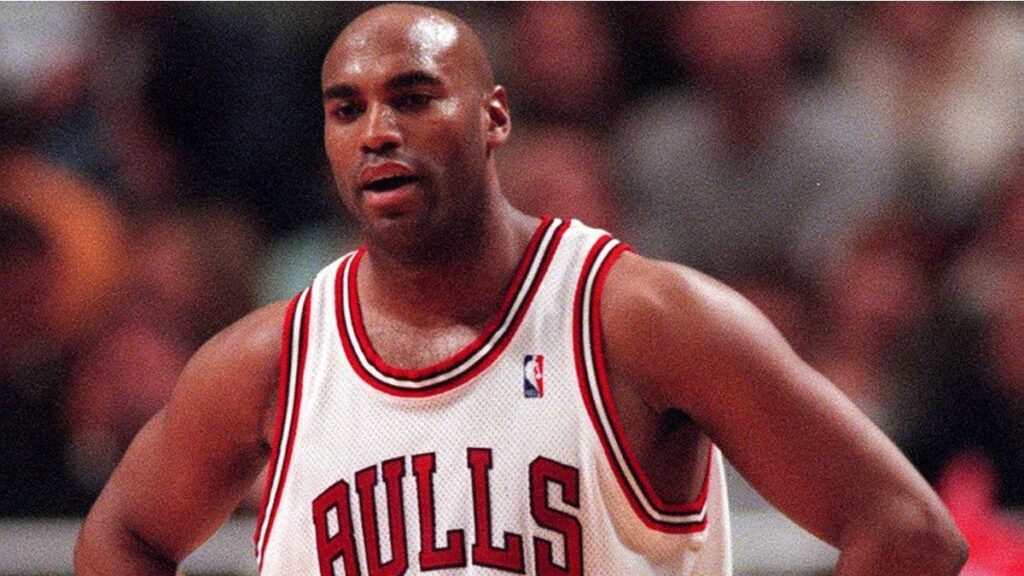
Talking to Scott Burrell serves as a sharp reminder that the Bulls dynasty wasn’t just built on talent; it was forged through a psychological endurance test. Burrell wasn’t just a spectator to history; he was a vital cog in a machine that demanded perfection. While the “Last Dance” eventually came to an end, the lessons Burrell learned—about work ethic, mental warfare, and the importance of spacing—continue to resonate. In a modern NBA dominated by high-scoring stats and massive contracts, Burrell’s story is a bridge back to an era where the only thing that mattered was answering the question: “What time is it?”