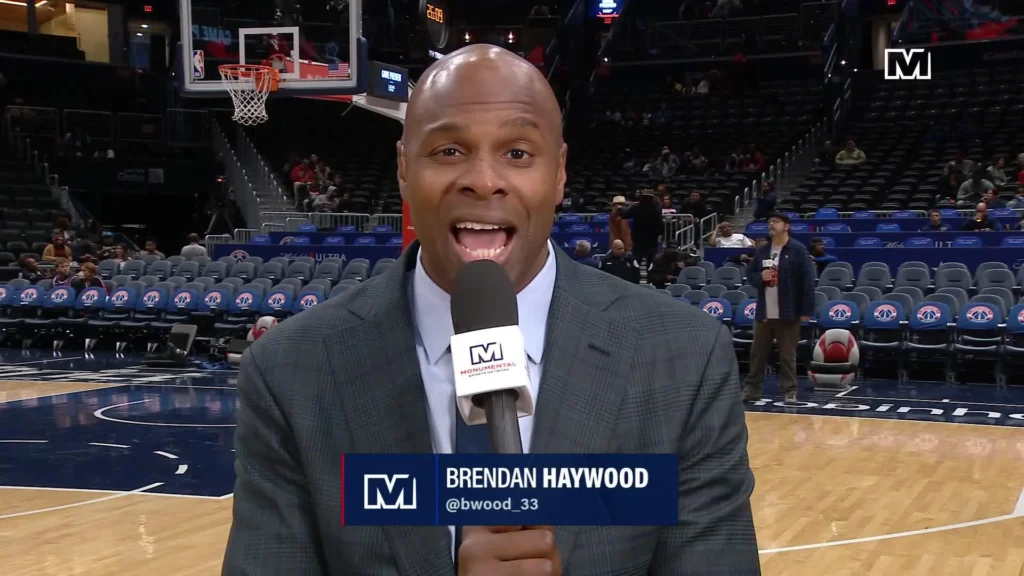
Brendan Haywood has always been a man who understands the value of doing the “dirty work” on the basketball court. Whether he was anchoring the paint for nearly a decade in Washington or providing the physical muscle for the Dallas Mavericks’ historic 2011 championship run, Haywood’s career was defined by defensive rotations, enforcer grit, and an unwavering loyalty to the game’s fundamentals.
During the NBA’s 2025-26 regular season, Haywood returned to his roots, taking a seat at the broadcast table for the Washington Wizards. But he isn’t just calling games; he’s reinventing how players transition into media. From his viral animated “Tallest Tales” to his nuanced defensive analysis, Haywood is bridging the gap between the physical era he dominated and the high-skill, positionless basketball of today.
Haywood and I caught up by phone to discuss his new role, the distinct leadership styles of icons like Michael Jordan, LeBron James, and Dirk Nowitzki, the “what-if” impact of Gilbert Arenas in the modern era, the media’s treatment of stars like Kevin Durant, and why he’ll never sacrifice his voice for a “hot take.”
The Q&A
Brandon “Scoop B” Robinson: You’ve recently taken on a bigger role with the Wizards’ broadcast team for the 2025-26 season. How has that experience as a defensive anchor changed the way you call a game compared to a guard-centric analyst?
Brendan Haywood: I think from a deep interest standpoint, the game changes. When you’re an offensive guy, you’re looking at how to score, obviously. But when you’re a defensive guy, you’re looking at the rotations. A lot of times, if somebody scores, I look at the reason why. I might see a driver and notice a strong-side help defender was in the wrong place or someone over-helped. I look at all the nuances I had to know as a defensive guy and bring that back to the analyst booth.
Brandon “Scoop B” Robinson: You are one of the few players who spent time in the locker room with both Michael Jordan and LeBron James. What is one specific leadership trait they both shared that the public rarely gets to see?
Brendan Haywood: It’s that dedication and that grind—it just comes off different. When people look at Mike and LeBron, they see two totally different leadership styles, but they want the same thing. They both want to win and they both want you to work hard. Mike’s more in your face; LeBron is more diplomatic—he’s going to let it play out and see if you’re going to learn and grow. Mike was going to tell you what it is, and if you didn’t do it, you had issues.
Brandon “Scoop B” Robinson: From your experience, whose leadership style was more like Michael’s and whose was more like LeBron’s?
Brendan Haywood: I would say Dirk was more like LeBron; he wasn’t the “in your face” guy. I don’t know if I played with anybody that truly had Mike’s leadership style, but Jerry Stackhouse was similar. When Mike left, Stack was more of that “in your face” type leader.
Brandon “Scoop B” Robinson: That 2011 title with the Mavs is often called the ultimate underdog story. Aside from Dirk’s brilliance, what was the one defensive adjustment or unsung hero moment that truly sealed that series against the Heat?
Brendan Haywood: The unsung hero for the whole playoffs was Shawn Marion. When you look at his responsibility from series to series, I’m not sure if there’s ever been a defensive player on a championship team asked to do more. First series, guard Brandon Roy. Next, Kobe Bryant. Against OKC, he bounced between James Harden, Russell Westbrook, and Kevin Durant. Then against the Heat, he had to hold his own against LeBron and D-Wade. We actually had to pull him off LeBron and put him on Wade to slow down that post-up. We couldn’t have done it without him.
Brandon “Scoop B” Robinson: You played in an era of true enforcers. When you watch the “positionless” basketball of today, which current center do you think would have struggled the most banging in the post against you and Tyson Chandler?
Brendan Haywood: I can’t say that anybody would struggle; I think they would have adapted. These guys are so much more skilled today. A guy like Jokic would have just taken us out to the perimeter. Back then, we weren’t used to guarding beyond 15 feet. Guys like Joel Embiid would have just taken us down to the deep end and dropped us off. Every team has a stretch four and stretch five now, which didn’t really exist in the early 2000s.
Brandon “Scoop B” Robinson: What would Andre Blatche look like in today’s NBA?
Brendan Haywood: Andre Blatche would be celebrated and on all the highlights because he was simply ahead of his time. A 6’10” guy with a handle, a crossover, and a step-back? In 2009, that was rare. Today, that’s normal. His game would be so much more appreciated in this era.
Brandon “Scoop B” Robinson: What about Al Harrington?
Brendan Haywood: Al would still be a tough cover because he was strong and physical, but he’d have more guard skill today. They identify talent earlier now and teach those handles. He already had the ability to shoot, but in today’s game, he’d probably have even more of a handle.
Brandon “Scoop B” Robinson: You spent nine seasons with the Wizards. Looking at the franchise’s current rebuild, what is the most important veteran lesson the roster needs to learn to get back to the postseason?
Brendan Haywood: It’s team culture. You want that established so everybody knows what you’re about and how you play. That culture permeates the organization way before you see the wins add up. Look at OKC—they were one of the worst teams, but they knew they were looking for a certain type of guy and work ethic. They aren’t surprised at where they are right now.
Brandon “Scoop B” Robinson: The North Carolina pipeline is famous for its loyalty. Does that “Carolina Way” still influence how you talk about the game today?
Brendan Haywood: The Carolina family is incredible. We’re on a group chat that spans decades—Vince Carter, Antawn Jamison, Raymond Felton, Danny Green, Harrison Barnes, Sam Perkins. It’s a huge mix of stars and guys who didn’t stay in the league, like Ed Coda or Terrence Newby. That family atmosphere is something I’m still proud to be a part of.
Brandon “Scoop B” Robinson: What has been the hardest part of finding your voice in a media landscape that often rewards hot takes over deep analysis?
Brendan Haywood: The hardest part is not losing myself. I know attention is currency, but I can’t forget what it was like to be a player. I’m going to be entertaining and funny in my way, but I’m never going to take a joke too far. I never want to say something where, if I saw that player in person, he’d want to fight me on the spot. Some handle that line better than others, but that’s where I stand.
Brandon “Scoop B” Robinson: If those mid-2000s Wizards teams played today, do you think Gilbert Arenas would have averaged 40?
Brendan Haywood: I don’t think he’d average 40, but I think he could get to 32 or 35. Back then, his style was seen as “upsetting the apple cart” because people preferred the traditional Chris Paul or Jason Kidd style. Today, he’d be celebrated. He would be very similar to Damian Lillard, just a little bit bigger.
Brandon “Scoop B” Robinson: Throughout your career, you’ve dealt with every kind of reporter. Is there one question you always wish someone had asked you during your playing days?
Brendan Haywood: Honestly, I got asked everything—defense, offense, my upbringing, my background. I can’t think of one that was missed.
Brandon “Scoop B” Robinson: How do you use your platform to show the human side of the guys you cover?
Brendan Haywood: I try to educate the fans without disrespecting the players. If someone takes a bad shot, I won’t say “that’s the dumbest shot in the world.” I’ll say, “that’s probably not the shot the coaching staff wanted coming out of a timeout.” I try to make the point while acknowledging they’re human.
Brandon “Scoop B” Robinson: You’ve said publicly that the media disrespected Kevin Durant during the playoffs. Now that the series is over, do you still feel that way?
Brendan Haywood: Yes. I think the media did a poor job covering his injury. There were reports saying his teammates didn’t know what was going on, which is very disingenuous. As a guy who has been in the locker room, if you ask me about a teammate’s injury, I’m going to say “I don’t know” because it’s not my place to speak on it. People were saying he was faking, but the man has a bone bruise. We saw this guy risk his Achilles for a team he was leaving; why would we question him now?
Brandon “Scoop B” Robinson: If you could go back and rewrite the LeBron James and DeShawn Stevenson beef from those Wizards-Cavs playoff series, would you change the outcome?
Brendan Haywood: I’d change the outcome so we won, but I wouldn’t change the moment. It was so organic and entertaining. Soulja Boy, Little Wayne—it was great theater. The fans loved it and they still talk about it today.
Brandon “Scoop B” Robinson: Does it make sense for LeBron to return to Cleveland one more time at the end of his career?
Brendan Haywood: At this point, LeBron gets to do whatever the hell he wants to do. He’s been an ambassador for the league for two decades and carried it on his back. We’re going to miss him when he retires. I have the utmost respect for how he’s carried himself.
Brandon “Scoop B” Robinson: I’ve marveled at your ability to tell stories that are now in cartoon digital form on social media. Where did the idea come from?
Brendan Haywood: It actually came from a perceived failure. I had been with Turner for ten years, and when they shifted more toward college ball, I thought I’d naturally move over. Instead, they brought guys out of retirement for those roles. It was an alert to me: I can’t let the “old guard” take work from me, and the younger guys are coming up too. I started the animation as a way to rebrand Brendan Haywood and highlight what I bring to the table. I love this game and I didn’t want to get phased out, so I did something about it.
Brendan Haywood remains a student of the game, but he’s graduated to a master storyteller.
Closing Out
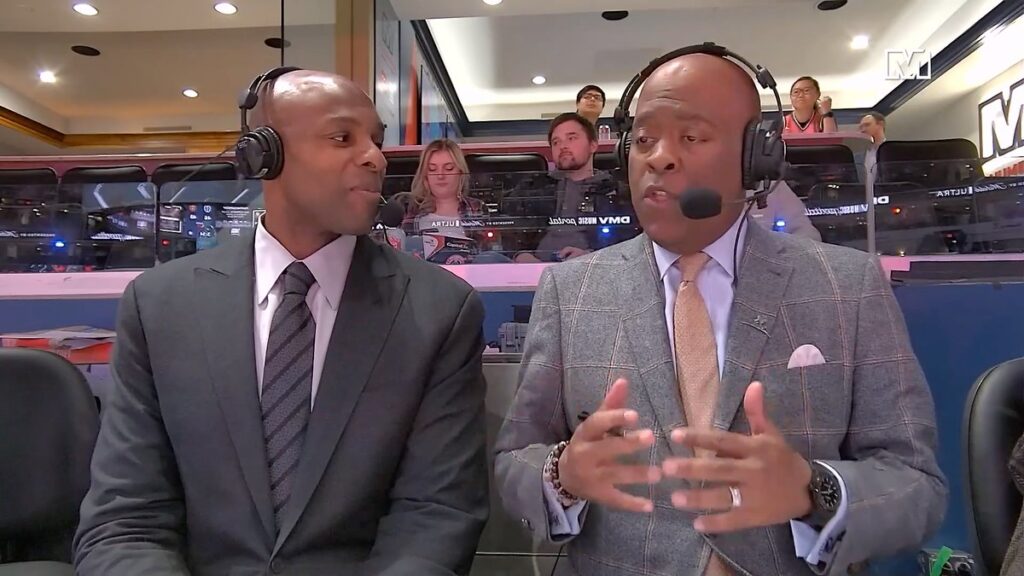
Whether he’s dissecting a botched weak-side rotation on a Tuesday night Wizards broadcast or sharing an animated memory of Michael Jordan on the UNC campus, he brings a level of integrity to the media that is increasingly rare. In an era of “attention currency,” Haywood has proven that you don’t have to be loud to be heard—you just have to be right.
As the Wizards continue their rebuild, they have one of the most reliable anchors in franchise history right there in the booth, reminding everyone that while icons like MJ, LeBron, Dirk, and Gilbert Arenas define the game’s past, and stars like Kevin Durant carry its present, the core principles of culture and authenticity are what define its future.