
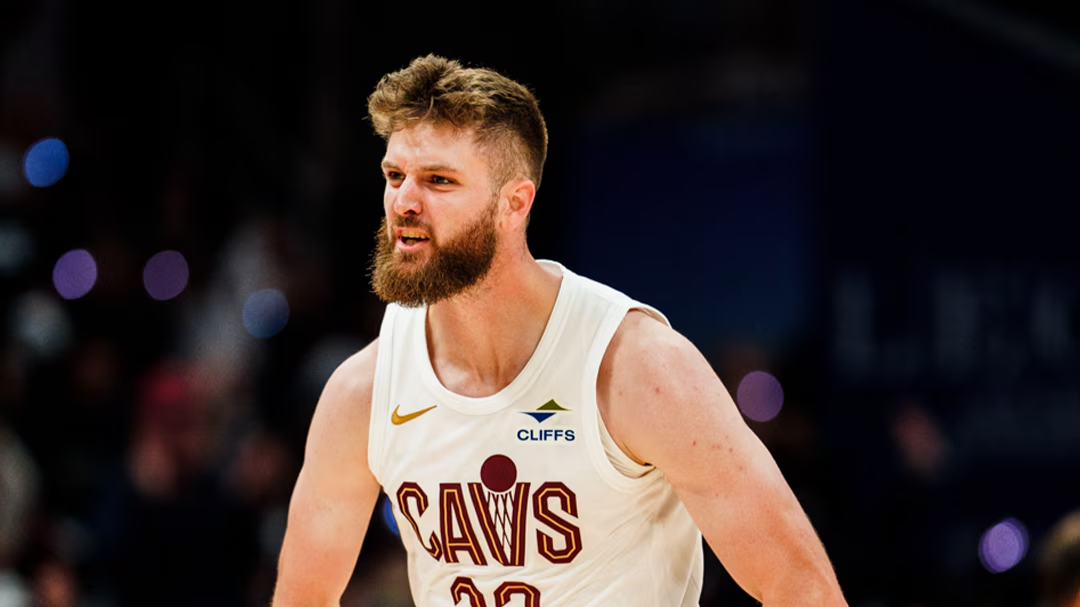
The Cleveland Cavaliers find themselves at a poetic crossroads in 2026. Exactly one decade after the franchise’s historic 2016 championship, the current roster is fueled by a similar blend of gritty defense and versatile floor spacing. At the heart of this modern rotation is Dean Wade, a player whose ability to scale between the small forward and center positions has made him an indispensable Swiss Army knife for a team eyeing another deep postseason run.
In our chat, Wade opens up about the silent mentorship he received from Cavs legend Kevin Love and how his game has shifted as he spends more time on the wing. From studying the footwork of elite perimeter defenders to the nuances of the “short roll,” Wade breaks down the technical details that allow him to thrive. It is a look inside the mind of a player who values balance and efficiency over raw athleticism, proving that the best way to move forward is often by carefully watching those who came before.
Brandon ‘Scoop B’ Robinson: People on social media love the “10-year challenge.” The Cavs won it all in 2016, and here in 2026, you guys are trying to repeat history. You’re a versatile player who can slide between the three, four, and five positions. How much Kevin Love film have you studied to prepare for that role?
Dean Wade: I don’t know if I’ve watched as much film on him as I did simply watching him work out when I was younger. I used to stay after practice just to observe his routine. By my second and third year, I was out there playing with him and watching how he operated in the short roll. Even as he got older and wasn’t quite as athletic as he used to be, he was still incredibly efficient. Back in the day, he was dunking and making plays—I mean, he had that legendary 30-30 game.
Brandon ‘Scoop B’ Robinson: Yeah, he’s a big man. Of course he was dunking!
Dean Wade: You’re right, but his foot speed was a little… you know what I mean. But he’s my dog. He played defense, too! Don’t let them lie to you; when he was younger, he was out there moving. He had a huge impact on my career just by doing what he normally did, without even realizing he was mentoring me.
Brandon ‘Scoop B’ Robinson: Who are some other “three-men” you admire? I like guys like Al Harrington and David Lee. Who else have you watched?
Dean Wade: Early in my career, I watched a lot of traditional forwards because I thought I’d be playing the four. Now that I’m playing more at the three, I try to take different pieces from guys, especially on the defensive end.
The way Tony Allen navigated screens was unbelievable. It’s the same with Jrue Holiday. The biggest thing with Jrue is that even if he gets beat, he somehow gets back in front of the ball. You can’t screen him and you aren’t going to “bully ball” him because he’s always on balance. I also watch Herb Jones—I love the way he plays defense—and Jaden McDaniels. They are bigger wings who are very effective. I try to take things from their game; I might not be as athletic as some of those guys, but they do certain things that I can definitely translate into my own play.
As the Cavaliers push toward the playoffs, Wade’s evolution from a traditional power forward to a versatile wing defender mirrors the league’s overall shift toward position-less basketball. By incorporating the recovery speed of Jrue Holiday and the screen-navigation of Tony Allen, Wade has transformed himself into a defensive specialist who can disrupt any lineup. His journey highlights a rare trait in the modern NBA: a willingness to be a “basketball sponge,” absorbing the best qualities of his peers to fill whatever gap his team requires.
While the comparisons to the 2016 championship team will continue to swirl, Wade and his teammates are focused on carving out their own legacy. With a foundation built on the work ethic he witnessed in Kevin Love and a defensive IQ honed by studying the league’s elite, Wade is prepared for the challenges that 2026 holds. If the Cavs do manage to complete the 10-year challenge with another trophy, it will be because of the quiet, disciplined contributions of players who understand that being “on balance” is often the greatest advantage of all.