
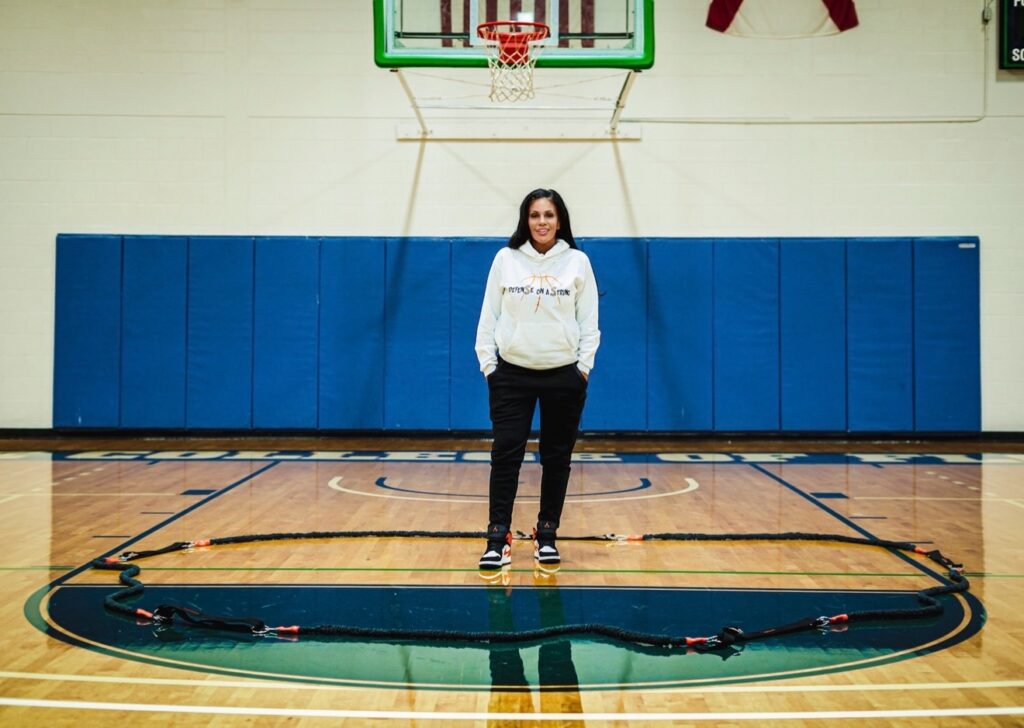
For decades, basketball coaches have paced the sidelines and barked the same metaphor at their players: “Imagine there is a string connecting all five of you!” The idea is foundational—when the ball moves, the entire unit must shift in perfect synchronization. However, as any coach knows, there is a massive disconnect between hearing a concept and executing it at game speed. For many athletes, particularly at the youth and collegiate levels, that “imaginary string” remains exactly that—imaginary—leading to late rotations, blown assignments, and a lack of defensive cohesion.
Enter Jennifer Sepielli, a veteran coach who decided that the best way to teach the abstract was to make it tangible. Her innovative training system, Defense On A String, has turned a coaching cliché into a high-intensity physical tool. By literally tethering players together with a specialized bungee and belt system, Sepielli has found a way to provide instant, “silent” feedback that film sessions simply cannot replicate. In this exclusive sit-down, she discussed how physical resistance is building the next generation of lockdown defenders.
Q&A With Jennifer Sepielli

Brandon “Scoop B” Robinson: Coaches have used the “imaginary string” analogy for decades. What made you decide it was time to make that string a literal, physical reality?
Jennifer Sepielli: I started coaching college basketball about 15 years ago, and almost immediately I noticed a major gap on the defensive side of the game. Coaches talk all the time about “moving on the flight of the ball,” but for a lot of players that idea stays abstract. It’s an imaginary string we reference verbally, but there wasn’t anything tangible to help players actually feel and see it in real time. Early in my coaching career, I kept running into the same problem: film study and video breakdowns are valuable, but they don’t help in the moment. Players process information differently, and some guys need something physical — not just words or clips to truly understand spacing, timing, and positioning on defense. Over the years, I kept coming back to this concept in practice, trying to find ways to make it more real for my players. The more I coached, the more obvious it became that this wasn’t just my team’s issue — it was a universal teaching challenge. That’s when it clicked that the “imaginary string” didn’t need to stay imaginary. Turning it into a physical tool was about giving coaches and players something they could use instantly, on the floor, to reinforce defensive movement and habits as they’re happening, not after the fact. That realization is what pushed me to finally bring the idea to life.
Brandon “Scoop B” Robinson: In a typical practice, a coach has to stop play to point out a missed rotation. How does your system provide “silent coaching” without the need to blow a whistle?
Jennifer Sepielli: In a typical practice setting, coaches often have to stop play to correct missed rotations, which disrupts flow and learning. Our system eliminates the need for whistles or verbal instruction by providing silent, real-time coaching through physical feedback. The Defense on a String system teaches players to feel when they are supposed to move rather than being told after the fact. As the ball is in flight, the connected resistance creates a subtle tug that cues each defender to rotate at the correct moment. This feedback happens instantly, reinforcing proper timing and spacing without stopping play or saying a word. Because the reminder is continuous and automatic, players begin to anticipate movement based on ball action instead of reacting to a coach’s voice. Over time, this builds instinctive rotations, sharper awareness, and team-wide synchronization—allowing coaches to teach concepts through repetition and feel rather than interruption and explanation.
Brandon “Scoop B” Robinson: What is the most common “bad habit” you see in players that is corrected almost instantly once they are hooked into the belts?
Jennifer Sepielli: The most common bad habit we see is ball-watching during rotation. Most players are fairly solid when guarding the ball, but defensive breakdowns usually happen off the ball—when the ball is moving and players either rotate late, miss their help assignment, or don’t move at all. Once players are hooked into the belts, that habit is corrected almost instantly. Defense on a String creates immediate awareness of ball movement by physically cueing players to rotate together. As the ball swings, defenders feel the connection and are prompted to move in unison, eliminating hesitation and missed help. This builds muscle memory for proper positioning and timing. Instead of reacting late or guessing where they should be, players are consistently guided into the correct spots. Over time, they learn what being in the right position feels like, resulting in a defense that moves as one unit and rarely misses a rotation.
Brandon “Scoop B” Robinson: How does Defense On A String help build chemistry between bench players and starters who might not be used to playing as a synchronized unit?
Jennifer Sepielli: Defense On A String helps build chemistry by creating instant communication and shared accountability between players—especially between starters and bench players who don’t normally get extended reps together. Because everyone is physically connected, players can immediately feel when a teammate isn’t doing their job. If one defender is late, out of position, or not pulling their weight, both the on-ball defender and the help defender sense it through the connection. That feedback doesn’t come from a coach—it comes from each other. This shifts accountability from the sideline to the floor. Players begin to self-correct, communicate more naturally, and trust one another’s movements. Bench players learn the exact timing and positioning expected of the system, while starters learn to rely on teammates they may not normally play alongside. Over time, the unit becomes more synchronized, connected, and confident—because everyone is responsible for the success of the group, not just the individuals on the court.
Brandon “Scoop B” Robinson: Training tools take a lot of abuse in a gym. What were the biggest challenges in designing a bungee and belt system that could withstand high-intensity collegiate or pro movements?
Jennifer Sepielli: One of the biggest challenges was building a system that could truly handle elite-level force and repetition. Collegiate and professional players generate explosive movements, sudden changes of direction, and constant tension, so durability wasn’t optional—it was the foundation. I spent a significant amount of time in the development phase testing materials, load limits, and long-term wear to make sure the system could withstand body weight, repeated stress, and time. We manufacture everything here in the United States and push the testing standards to the highest level—each unit is tested to 150,000 pulls, which is among the highest benchmarks anywhere in the world. Quality was the priority from day one. This wasn’t designed as a short-term training aid; it was built to last. The goal was to create a lifetime purchase—a tool coaches can trust in high-intensity practices year after year without worrying about breakdown or performance loss.
Brandon “Scoop B” Robinson: One of the hardest things to teach is “help-and-recover.” How does the tension of the cord physically guide a player back to their original man after they’ve helped in the paint?
Jennifer Sepielli: Help-and-recover is difficult to teach because it requires perfect timing—players have to help without overcommitting, then recover instantly once the ball is kicked out. That exact timing is where defenses usually break down. The tension of the cord solves this by physically guiding the player back to their original assignment. When a defender steps into the paint to help, the cord stretches. As the ball is kicked out and travels in the air, the tension naturally pulls the defender back toward their next correct position. At the same time, every other connected defender is also moving based on the ball’s flight, so the entire unit shifts together. There’s no thinking or guessing involved. The player doesn’t have to process a verbal cue—they simply follow the tension. Over time, players internalize the rhythm of helping and recovering based on ball movement. They learn exactly when to help, how far to help, and how fast to recover, building instinctive on-ball and off-ball movement without stopping play.
Brandon “Scoop B” Robinson: If one player is lazy, the whole line feels it. How have you seen this tool change the way teammates hold each other accountable during a drill?
Jennifer Sepielli: Normally, players don’t always realize when a teammate misses a rotation—especially off the ball. With Defense On A String, that changes immediately. Because everyone is connected, if one player is lazy or late, the entire line feels it. Now defense becomes a shared responsibility. If one defender doesn’t move on the flight of the ball, they physically pull against the group, and the on-ball defender closing out is instantly late because they’re carrying someone else’s body weight. The breakdown is obvious, and everyone knows exactly why it happened. This creates natural accountability between teammates. Instead of coaches calling it out, players correct each other in real time because they all depend on one another to defend properly. It reinforces the idea that great defense isn’t about one player—it’s about all five moving together, on time, every possession.
Brandon “Scoop B” Robinson: Can this system be used effectively for teams that play a 2-3 or 3-2 zone, or is it strictly designed for man-to-man principles?
Jennifer Sepielli: Yes—Defense On A String is designed to teach defensive principles, not just a single scheme. Because of that, it can be used effectively in man-to-man, 2–3 zone, and 3–2 zone defenses. At its core, the system reinforces fundamentals like moving on the flight of the ball, proper spacing, help-and-recover, and rotating together as a unit. Those principles apply to every defensive structure. Whether players are guarding a man or an area, they are still reacting to ball movement and adjusting their position accordingly. The system can be broken down to match specific concepts within each defense—on-ball pressure, gap help, closeouts, and rotations in zone. By feeling when and where they need to move, players learn how different coverages flow while maintaining team synchronization. This allows coaches to teach multiple defensive systems using one consistent tool, without stopping play or over-coaching.
Brandon “Scoop B” Robinson: Is there a specific team or player you’ve worked with where you saw a statistical “before and after” difference in their defensive efficiency after using the tool?
Jennifer Sepielli: Yes—one of the teams I can name are the teams coached by Gary Payton, who I’ve worked with personally. While we didn’t frame it strictly as a “numbers-only” experiment, the before-and-after impact on defensive efficiency was clear on the floor. Coach Payton firmly believes in the system because of how quickly it helps players understand defensive concepts. By using Defense On A String every day in practice, his teams showed noticeable improvement in muscle memory, foot speed, rotation timing, and overall defensive awareness. Players were more connected, reacted faster on ball movement, and made fewer mistakes on help-and-recover situations. The biggest difference was consistency. Defensive principles stopped being something players talked about and started becoming automatic. That translated into cleaner rotations, better closeouts, and a more disciplined, efficient defense during live play—exactly what the tool is designed to produce.
Brandon “Scoop B” Robinson: Where do you see this technology going? Do you envision a future where every youth program starts with physical tethering to teach the fundamentals of spacing?
Jennifer Sepielli: Defense On A String is already being used by teams around the world, and we believe it’s a tool that every level of basketball can benefit from, from youth programs to the professional game. Defense is built on fundamentals, and almost every program uses the Shell Drill as a staple to teach spacing, help, and rotation. What Defense On A String does is evolve that drill. By adding physical tethering, coaches and players get maximum reps, real-time feedback, and correct rotations happening automatically, without stopping practice to correct mistakes. For youth programs especially, this accelerates learning. Instead of explaining concepts over and over, players learn by feel. As they grow, those habits carry over into more advanced schemes. The long-term vision is that physical tethering becomes a foundational teaching tool—just like cones or shells—so players develop proper defensive spacing and movement from day one, without slowing down practice or relying solely on verbal instruction.
Wrapping Up
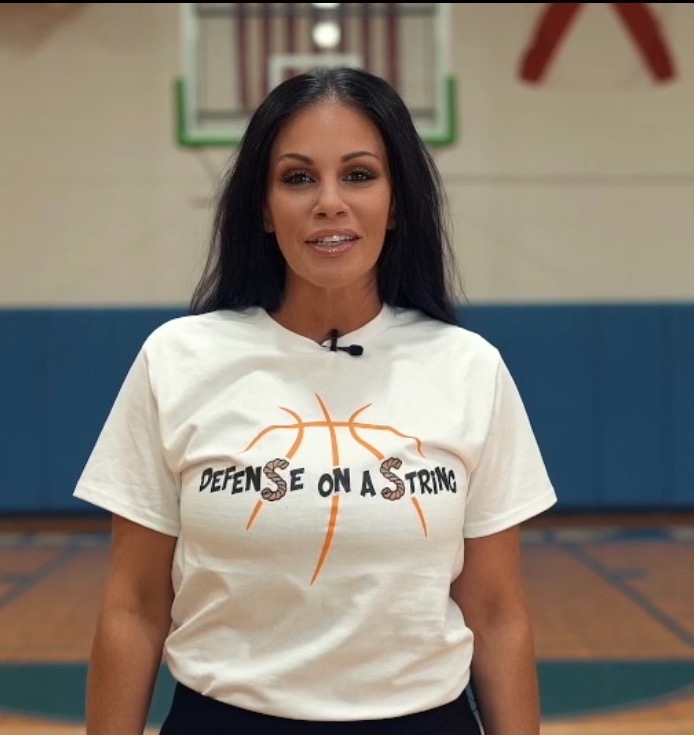
The evolution of basketball training has largely focused on the individual—better handles, a quicker release, and more explosive verticality. However, Sepielli’s work serves as a reminder that basketball is, at its heart, a game of interconnected geometry. By taking the guesswork out of help-side defense and forcing players to operate as a singular organism, “Defense On A String” is filling a gap that verbal coaching alone simply couldn’t bridge. As the game becomes faster and floor spacing more difficult to manage, these physical cues are becoming the “secret sauce” for teams looking to squeeze every ounce of efficiency out of their defensive schemes.
Looking ahead, it isn’t hard to imagine a world where the bungee system is as common in a gym as a rack of basketballs. From the endorsement of legends like Gary Payton to its adoption by grassroots programs, the movement Sepielli started is proving that the best way to get players on the same page is to literally put them on the same string. As the interview suggests, when you stop talking about rotations and start feeling them, the results speak for themselves. The “imaginary string” is gone; in its place is a tangible path to championship-level defense.