
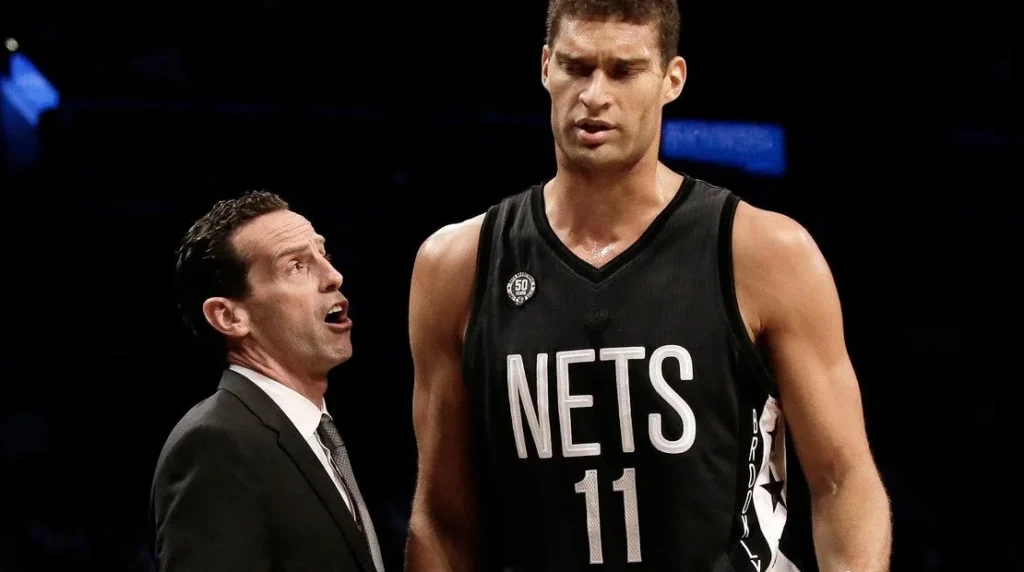
LOS ANGELES — Long before Brook Lopez became the prototypical stretch five—a 7-foot rim-protector who doubles as a lethal perimeter threat—he was a traditional, low-post anchor. Equipped with a reliable mid-range touch out to 16 feet and an array of back-to-the-basket moves, Lopez dominated the paint in the early half of his career.
Now in his 19th NBA season and back in Los Angeles as a core veteran anchor for the LA Clippers, the 2021 NBA Champion, NBA All-Star, two-time All-Defensive Team selection and Brooklyn Nets all-time leading scorer has carved out one of the most durable and unique careers in modern basketball history.
However, as the NBA rapidly evolved toward space, pace and heavy three-point volume, Lopez underwent one of the most remarkable game transformations in modern sports history.
Speaking about the conscious evolution of his game, Lopez opened up about the pivotal moment in his career: his time with the Brooklyn Nets and the arrival of head coach Kenny Atkinson.
“He really allowed me to play my game and let me play freely,” Lopez revealed to ScoopB.com. “I always felt like I had that touch, even going back to hitting those 16-to-18 footers early on. But when Kenny came to Brooklyn, he came in with a completely different mindset for how a center could operate in a modern offense.”
When I spoke with Lopez, I brought up former Cleveland Cavaliers All-Star Zydrunas Ilgauskas, telling him that watching him operate in space reminds me of a faster “Big Z”—a seven-footer with the touch and footwork to stretch defenses comfortably from 16 to 18 feet and seamlessly extend all the way out to the three-point line. I also shared with him that not only did I see Ilgauskas prolong his career that way, but as the game evolved during the Steph Curry-dominated Golden State Warriors era—where players at all five positions began shooting far more three-pointers—Lopez, Dwight Howard and Al Horford each evolved from traditional post players into roaming, adaptable big men. And it shows, because all three prolonged their careers and have NBA championship rings to show for it.
Atkinson, who helmed the Nets from 2016 to 2020, is widely credited with empowering Lopez to take that range beyond the arc. Prior to the 2016-17 season, Lopez had attempted just 31 three-pointers total across his first eight NBA seasons.Under Atkinson’s guidance, that script was completely flipped: Lopez launched 387 three-pointers in a single season, transforming overnight into a primary floor-spacing threat in a modern five-out offensive structure.
“It wasn’t just a matter of stepping back and throwing them up,” Lopez explained. “Kenny really brought over a ton of mechanics and concepts from his time as an assistant with the Atlanta Hawks. He studied how and what a center should play in space—how to read the defense, step into the flow of the offense and trust the work put in every single day.Having a coach look at you as a center and say, ‘If you’re open, let it fly,’ gave me all the confidence in the world.”
That philosophy directly mirrors what Atkinson shared with me last season during our conversation in Cleveland regarding his positionless “2K Blueprint.” When breaking down his affinity for size, versatility and floor spacing—like sliding 6-foot-9 forward Dean Wade to the five while surrounding him with tall, versatile guards—Atkinson emphasized that creating unmatched positional leverage and open-floor spacing is simply a core part of his identity.
What began as a radical experiment with Lopez in Brooklyn has become the bedrock of Atkinson’s tactical blueprint across the league: taking big men out of traditional boxes and maximizing total lineup flexibility.
That initial breakthrough set the stage for the next phase of Lopez’s career in Milwaukee and his sustained longevity. As reported in a feature by Landon Buford for Hoop Herald, former Bucks head coach Mike Budenholzer praised how Lopez’s floor-spacing revolutionized Milwaukee’s offense, noting, “Brook’s ability to stretch the floor opened up everything for us—it allowed Giannis to attack the paint with total freedom while keeping defenses completely off-balance.”
Teammates Giannis Antetokounmpo and Jrue Holiday have echoed that sentiment highlighting how Lopez’s dual-impact as an elite rim protector and lethal perimeter threat served as the key operational engine behind Milwaukee’s 2021 NBA Championship run.
Reflecting on his continuous evolution during the Basketball Without Borders Next Up program in Istanbul, Lopez shared his philosophy on longevity as per Buford: “The key to playing this long in the NBA is adaptability,” said Lopez. “You can never stop learning, and you can’t be afraid to embrace new approaches to the game.” When asked about his career timeline, Lopez added that he has completely removed any artificial limits on his playing days: “I used to put a cap on how long I’d play, but now my goal is reaching 20 seasons—and honestly, why stop there if the body and mind feel great?”
That mindset shows up in the quiet details before the arena lights even turn back up. During our conversation, I told Lopez that what I have admired most about him—even amid the Clippers’ early struggles this season—is watching him emerge at halftime as the very first player back on the floor before the start of the second half, hoisting up jumpers to get warm and locked in before finishing the game.
“Thank you,” Lopez said. “I always aim to be the first on the court because I like to set an example and it is important for me to be prepared.”
In reinventing his offensive identity nearly a decade into his career, Lopez joined a rare fraternity of legendary NBA big men who prolonged their primes by trading low-post wear and tear for perimeter skill and basketball IQ. Much like how Kareem Abdul-Jabbar leaned into the unstoppable skyhook into his forties, Tim Duncan transitioned into a high-post facilitator and mid-range specialist for San Antonio’s late-dynasty runs, Dirk Nowitzki perfected his one-legged fadeaway to remain lethal into Year 21 and Horford and Howard adapted their games to capture titles later in their careers, Lopez refused to let the modern game pass him by.
By stepping out to the three-point line under Atkinson in Brooklyn, Lopez not only extended his career trajectory but also helped redefine expectations for modern NBA centers. Through 12 games this season with the 4–8 Clippers, that transformation continues to pay dividends: the 38-year-old center is averaging 14.1 points, 5.3 rebounds and 1.8 assists per game while shooting an efficient 53.5 percent from the field and 40.5 percent from three-point range, serving as one of the brightest spots and steadiest veteran anchors for Los Angeles.