
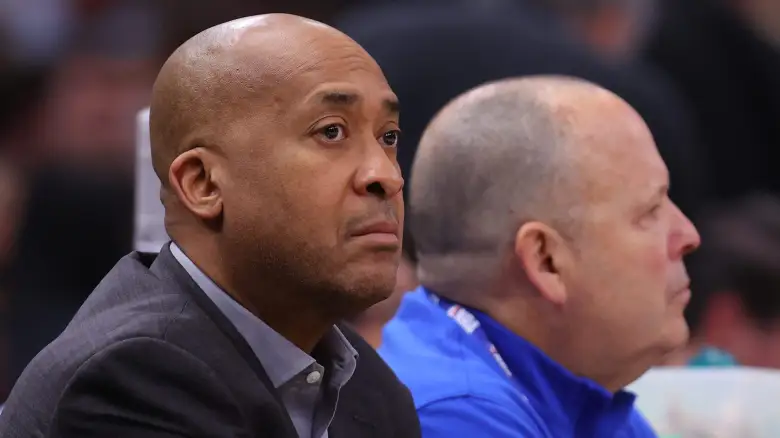
During a recent sit-down on The Pull Up With Scoop B, veteran sports journalist Robert “Scoop” Jackson joined me to discuss Wesley’s legacy, how Jackson accidentally blew his cover to mainstream media and why modern sports culture won’t allow another “shadow broker” to exist.
The Architects of Influence: Early Bridges to NBA Royalty
Long before formalizing his executive career, Wesley cultivated deep, foundational relationships across every era and tier of modern basketball. His entryway into elite basketball circles began through a close personal connection with Julius “Dr. J” Erving. Serving as an early bridge into NBA royalty, Wesley’s relationship with Erving provided him with immediate credibility and an inside look at how high-level sports figures navigated fame, business, and personal branding.
That early access paved the way for Wesley to establish himself as one of Michael Jordan’s closest personal confidants. For years, Wesley seamlessly navigated His Airness’ inner circle, proving his loyalty and discretion while gaining rare, behind-the-scenes exposure to the highest levels of global sports branding and executive power.
Guiding the Next Generation: Mentorship & Megastars
As a new era of talent emerged, Wesley’s influence only deepened. He maintained a pivotal role as a trusted advisor to LeBron James early in his career, helping bridge crucial corporate relationships, navigate personal agency transitions, and secure top-tier industry access during James’ rapid ascent from high school phenom to global icon.
Wesley also served as a dedicated personal mentor and key figure in the inner circle of Richard “Rip” Hamilton. Guiding the star guard from his collegiate days at Connecticut all the way through his championship-winning run with the Detroit Pistons, Wesley demonstrated a unique ability to manage both the personal and professional dynamics required to sustain long-term success in professional sports.
The Cultural Bridge: Connecting Hoops & Hip-Hop
Wesley’s reach extended far beyond court dimensions—he was one of the earliest architects to bridge the gap between elite basketball culture and hip-hop royalty. As Jay-Z expanded his business portfolio into sports ownership and agency representation with Roc Nation Sports, Wesley served as an influential, behind-the-scenes sounding board, standing squarely at the intersection of music, lifestyle, and executive power.
Wesley’s footprint even extended into Toronto’s hip-hop domain. Drake famously immortalized him on the 2011 track “Pound Cake,” shouting out Wesley’s legendary status and omnipresent courtside presence with the line: “I’m World Wide Wes, the light-skinned Keith Sweat.”
The Clout Economy Killed Absolute Discretion
When asked if the sports world could ever produce another figure with Wesley’s level of influence, Jackson’s answer was immediate: someone might replicate the connections, but no one can match the silence.
“Today, people are too thirsty for clout,” Jackson explained. “Wes moved in the shadows for decades out of calculated precision.”
For years, Wesley operated as a silent connective thread bridging the highest levels of the NBA, NCAA, hip-hop, and national politics—building an empire of influence purely on trust, proximity, and zero desire for public recognition.
The 2005 ESPN Column That Blew His Cover
Wesley’s intentional anonymity was disrupted in 2005 when Jackson made his high-profile move from SLAM Magazine to ESPN. For his introductory piece—titled “Scoop’s Manifesto”—Jackson included a single line highlighting Wesley’s reach:
“I believe the second most powerful person in sports behind Phil Knight is William Wesley.”
While SLAM readers were already familiar with Wesley’s behind-the-scenes pull, the mainstream exposure triggered a massive industry reaction. Mainstream executives, sports fans, and major outlets began scrambling to figure out who Wesley was and how he yielded so much authority across basketball circles.
Shortly after the column went live, Wesley reached out to Jackson directly:
“Wes called me up—he wasn’t angry, but he said, ‘Man, I’ve been moving in silence for 20 years, and you blew me up in one line!’” Jackson recalled.
The article sparked widespread media intrigue, leading to profiles in outlets like GQ and The New York Times as journalists tried to pull back the curtain on the NBA’s ultimate insider.
From Shadow Power to Executive Legitimacy
Today, Wesley’s authority is fully formalized. As a senior executive with the New York Knicks working alongside team president Leon Rose, his role sits in the front office rather than behind closed doors.
“As an executive with the New York Knicks… Wes has a different type of power,” Jackson noted. “He’s legitimized in the public space now, which is a great career evolution. But back when he was World Wide Wes, the power and mystique he held across the NBA, NFL, NCAA, hip-hop, and politics was completely unprecedented.”
In an era dominated by content creation and constant self-promotion, the era of the invisible power broker has effectively closed. World Wide Wes set a standard of quiet authority that today’s media landscape won’t allow to happen again.