
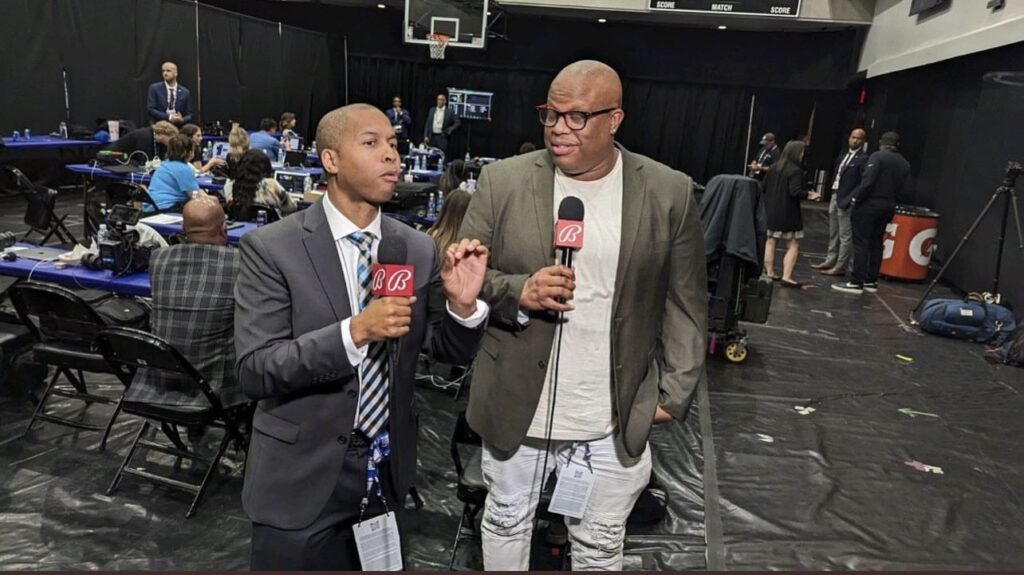
In the world of basketball evaluation, few voices are as distinct and forward-thinking as Rashad Phillips. Often referred to as the “Yoda” of scouting, Phillips is a master talent evaluator and a self-described Basketball Evangelist whose expertise is backed by a legendary playing career. A former Detroit Mercy standout, Phillips remains the Horizon League’s all-time leading scorer and a two-time Player of the Year—accolades that paved the way for his deep understanding of the game’s nuances.
Today, as the Owner of Prestige Management Group, Phillips has transitioned from breaking ankles on the court to breaking down film for the next generation. This includes keeping a close eye on elite family talent like his nephew, Darius Acuff Jr., the standout Arkansas freshman. Phillips is also the author of the groundbreaking book “Basketball Position Metric,” where he dives into the mental and physical architecture of modern players.
I recently sat down with Phillips to discuss the meteoric rise of Luka Dončić, the flaws in traditional scouting, and why he believes the basketball terminology we’ve used since the 1940s is overdue for a factory reset.
Brandon “Scoop B” Robinson: You’ve been very vocal about your evaluation process. Looking back to when the Dallas Mavericks first drafted Luka Dončić, what was your initial diagnosis, and how has that evolved seeing him become a perennial MVP candidate today?
Rashad Phillips: At the end of the day, we in this country don’t watch Euroleague Basketball, you know? We don’t watch it because it’s not televised enough. So for me, I didn’t have enough information back then to really come up with an accurate diagnosis of who he is. But Luka is a highly skilled guy; I’ve said that from day one. I’ve really loved how he’s been able to use that skill set in transitioning to the NBA and not only be a good player or a great player, but really elevate to a superstar level.
You know this better than me, Scoop—in the business that we’re in, especially in the evaluation business, you’re going to miss some and you’re going to get some right. For me, I’ve got more right than wrong, and I really love watching the kid play today. He’s proved me wrong. Keep going, Luka! Keep doing what you do, bro!
Brandon “Scoop B” Robinson: When people see a player of Luka’s size and vision, the comparisons immediately fly toward LeBron James and Magic Johnson. Do you see him in that same lineage of “Point Gods,” or is he something else entirely?
Rashad Phillips: I don’t think that he’s like none of them, but I do think that he plays the same position as LeBron James. Magic Johnson was a point guard. I don’t think Luka Dončić is a point guard. I don’t think LeBron is a point guard. I think they’re Dual Forwards. I think they play the same position given their skill set. But again, when you’re drawing comparisons to guys like that, that means you’re doing something special. Especially Magic Johnson and LeBron James… two of the greatest players ever to play.
Brandon “Scoop B” Robinson: You’ve gained a lot of traction for your unique breakdown of positions. Why was it necessary for you to create a new “vocabulary” for how we describe players in today’s era?
Rashad Phillips: As we look at the world, Scoop, everything’s about evolution, right? The cars that we drive have evolved. The TVs that we watch—hell, we’re doing an interview through computers. Everything is about evolution. So when you look at the game of basketball, the players have evolved from back in the 1940s and 50s when we used to call them guards, forwards, and centers.
Today’s players are different model vehicles than what we watched in the 60s and 70s. What I tried to do is not reinvent the wheel, but update it. I categorize players depending on their skill set. I shaped certain position names to fit these slots for the evolution of players like a LeBron James or a Steph Curry—guys that don’t fit a traditional slot. I try to be innovative. We’re still calling players what we called them in 1946. It’s 2026. It is time for an update.
Brandon “Scoop B” Robinson: Break those slots down for me. If we aren’t using “1 through 5” anymore, how are we identifying the elite talent in the league?
Rashad Phillips: I’ve got the TG (Traditional Guard)—that’s like a Lonzo Ball, a player that goes above and beyond to facilitate. Then you have the Point Guard, which is a perfect blend of facilitation and scoring.
Then you have the Hybrid Guard—that’s the King Cobra of the NBA. That’s Steph Curry, Damian Lillard, Jamal Murray, Kyrie Irving, and James Harden. They are mistaken for point guards, but they are hybrids. Like a car, “hybrid” means gas and electric; they can do both. Russell Westbrook falls there too.
You have the Combo Guard, like a CJ McCollum. Then the Dual Forward, which is Giannis Antetokounmpo, LeBron James, and Luka Dončić. Julius Randle is a Dual Forward as well; Larry Bird was one too. Then you have the Hybrid Post—the Kevin Garnett position—think Anthony Davis, Bam Adebayo, or Zion Williamson. Finally, you have the Point Center like Nikola Jokić. They’re rare, but there’s a lineage: Chris Webber, Vlade Divac, Arvydas Sabonis, and Marc Gasol. When you dig into history, you find the players that fit these slots.
Brandon “Scoop B” Robinson: It’s interesting to see how you categorize modern stars, but what about the blueprints? If Michael Jordan and Kobe Bryant were playing in today’s position-less era, do they get a new title, or do they stay put?
Rashad Phillips: They’re just Shooting Guards. There are certain players whose slots don’t move because they are the ideation for those positions. Michael Jordan and Kobe Bryant are the ultimate shooting guards.
A lot of people get fascinated with these metrics and they want to shift players around—I get a lot of questions about Kevin Durant. People ask, “Shouldn’t KD be a Dual Forward?” No. Kevin Durant is a Small Forward; it’s just that he’s a great scorer. Dual Forwards are the engines to their franchise. Kevin Durant is a great scorer—maybe one of the best we’ll ever see—but he stays in his slot.
Whether he is identifying the next “King Cobra” of the league or helping fans unlearn decades of outdated terminology, Phillips remains at the forefront of the game’s intellectual shift. As the league continues to trend toward position-less versatility, his “Basketball Position Metric” isn’t just a new way to read a roster—it’s the definitive roadmap for the future of the sport.
With elite talents like Luka Dončić continuing to shatter the traditional mold, Phillips’ mission is clear: the game has evolved, and it’s time our conversation about it did the same.
For more on Rashad Phillips and his evaluations, follow him on social media and check out his latest work at Prestige Management Group.