
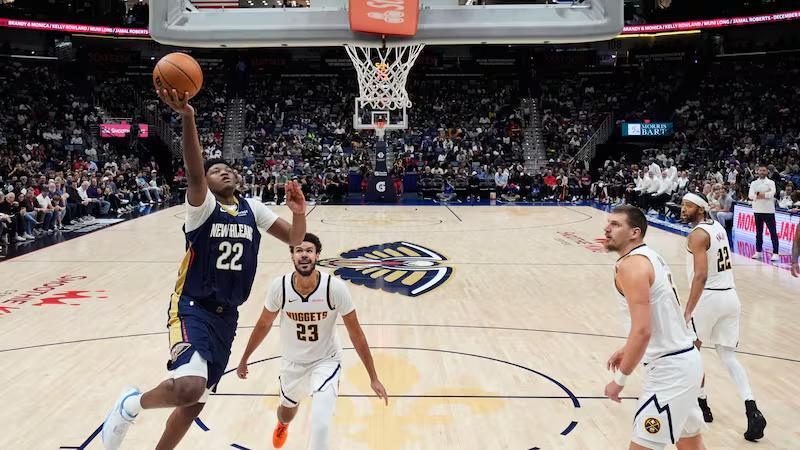
The narrative surrounding the modern NBA center often oscillates between two extremes: the high-flying rim protector or the floor-spacing sniper. Yet, New Orleans Pelicans rookie Derik Queen is carving out a third path—one paved with elite footwork and a “point-center” vision that defies his age. From the hardwood of Montverde Academy to the physical gauntlet of the Big Ten at Maryland, Queen arrived in the league as a polished anomaly. He doesn’t just occupy space in the paint; he orchestrates it, turning a simple post-up into a masterclass of leverage and IQ.
Critics once pointed to his conditioning as a hurdle, but Queen’s journey to the professional ranks has been defined by a quiet, disciplined transformation. A pivotal senior year, marked by an unexpected health scare and a revamped approach to nutrition, saw him arrive at the NBA Draft leaner and more mobile than ever before. This shift didn’t just improve his stamina; it unlocked a defensive versatility that allowed him to rack up steals and disrupt passing lanes, proving that positioning and intellect can be just as lethal as a 7-foot-3 wingspan.
As the Pelicans wrap up a challenging 2025-26 campaign that saw the team finish with a 26-56 record, Queen has emerged as a rare bright spot and the ultimate connective tissue for the franchise’s future. Over 81 games, the rookie averaged an impressive 11.7 points, 7.1 rebounds, and 3.7 assists per game, flashing a level of versatility that is rare for a first-year center. Perhaps most impressively, he maintained this production while navigating a season of immense instability, successfully playing under two different head coaches following the mid-season transition from Willie Green to interim coach James Borrego.
To get a deeper look into how he’s processing this transition and the specific influences behind his game, I sat down with the Pelicans’ standout rookie. We discussed everything from his archival approach to footwork to the “lightbulb moment” that changed his physical trajectory. What follows is a conversation about growth, hometown pride, and the IQ required to thrive in the modern NBA.
Brandon “Scoop B” Robinson x Derik Queen: The Q&A
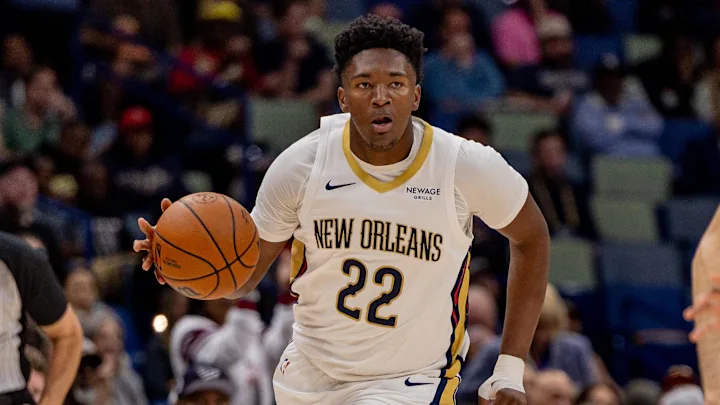
Brandon “Scoop B” Robinson: You’ve been praised since your time at Montverde for having some of the best footwork of any big man entering the league in years. Who were the specific players you watched to develop that “ballet in the paint” style—was it more Tim Duncan, Hakeem Olajuwon, or someone else?
Derik Queen: I don’t even know. I felt it was natural. I can’t dance, though—but I can dance on a court. I ain’t gonna lie. I feel that was natural. I still be trying today; I made some BS moves, but I still try to work on Melo’s mid-post, his footwork, and just different ways to get open. And Tim Duncan—how he got open, finished backwards, and stuff.
Brandon “Scoop B” Robinson: You were a massive recruit for Kevin Willard and stayed home to play for the Terps. Looking back at that lone season in College Park, how did playing in the physical Big Ten prepare you for the nightly “grown man” battles you’re facing now in the NBA?
Derik Queen: Oh, that’s my guy. He just called me actually. I love Willard. We played with two bigs, me and Ju. We was just going out there hooping. We both averaging probably 8-9 rebounds a game. We was just winning. I think that helped, and my strength coach, Kyle Tarp, definitely got us right.
Brandon “Scoop B” Robinson: One of the most underrated parts of your game is your ability to play-make. You’ve had games with 7+ assists this season, which is rare for a rookie center. When did you realize you had that “point-center” vision to find cutters before the play even developed?
Derik Queen: I’d probably say middle school. In college, I kind of fell away from it because if you take two dribbles, it don’t matter if I can lead them to the basket, it’s still not an assist. My numbers was down there, but I feel it was just natural. If I see somebody open, I can hit them. This year was up and down with my role, but the times that I had the opportunity, I try to make the best of it.
Brandon “Scoop B” Robinson: Coming out of high school, critics questioned your conditioning, but you showed up to the NBA Draft looking significantly leaner and more mobile. What was the “lightbulb moment” where you realized you had to change your diet and training to keep up with the NBA’s pace?
Derik Queen: I ain’t gonna lie. My senior year really helped me—underrated—but I got sick. I got food poisoning and lost 12 pounds in four days. It was really bad. And then I just never looked back. Plus I lived with one of my teammates, Liam. His mother used to cook and make sure it was clean. When I got to college, Kyle Tarp made sure he tracked the info after the practices and the games.
Brandon “Scoop B” Robinson: The scouting reports said you weren’t a “traditional” rim protector, yet you’re holding your own and racking up steals. How have you adjusted your defensive positioning to use your hands and IQ to make up for not being a 7-foot-3 “lob threat” blocker?
Derik Queen: They just be telling me to use my IQ on defense like I use it on offense. Try to anticipate, just be active, stay in a stance, and anticipate.
Brandon “Scoop B” Robinson: You’ve landed in a frontcourt with some unique talents in New Orleans. How has playing alongside veteran playmakers helped you simplify your game, and what has been the biggest “Welcome to the NBA” moment for you so far?
Derik Queen: I can go down a list. When I was starting, it was me and Murph. Murphy’s getting the backdoor; I was getting Murph open, Z. Just try to take some gravity off of her to help. Sadiq also takes some gravity off. Usually Herb got a defender that’s in help, so I just try to make a move and kick it to him. I can go down the list of how I use my playmaking to make this team better, try to make my teammates better, and try to perform.
Wrapping Up
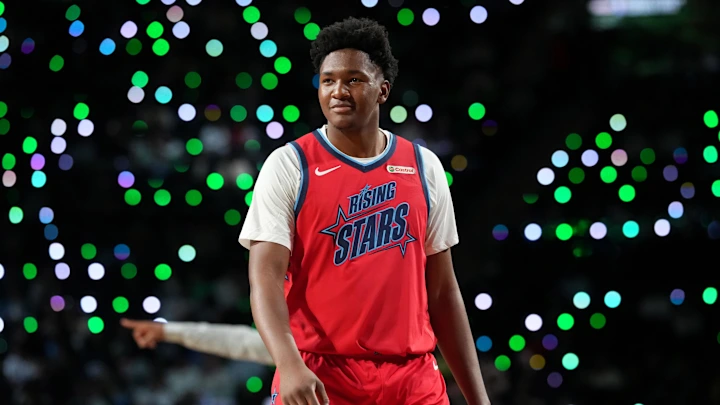
To watch Queen on the court is to witness a player who has already bridged the gap between raw potential and professional execution. Despite a tumultuous season for New Orleans that saw the franchise pivot through internal changes, Queen remained a steadying force, appearing in 81 contests and anchoring a rotation that often looked to him for offensive fluidity. His ability to navigate the transition from Willie Green’s system to the pace prioritized by James Borrego speaks to a high-level adaptability that usually takes veterans years to master.
Brandon “Scoop B” Robinson: You went viral during your college days for jokingly saying you listen to your coach because “he did pay us the money.” Now that you’re on a professional NBA contract, has that philosophy changed at all, or is the motivation still the same?
Derik Queen: Oh, yeah, definitely. Troy Weaver, our GM—I listen to him, but I do be giving him a headache. I’m going to give everybody a headache. Joe Dumars? Not so much of a headache, he’s more of an intimidator. But I just be trying to make the best of it. Just try to bring light to the room, bring jokes and stuff. My coaches play a part in that too because they put me out there and performed. I try to make the best of it by joking and giving people headaches because that’s just my personality and why people like being around me.
Brandon “Scoop B” Robinson: How excited are you to workout with DeAndre Jordan this summer in LA?
Derik Queen: It’s fellowship. I can’t wait!
The rise of Derik Queen is also a testament to the surging basketball culture of Baltimore, a city that continues to export elite talent to the highest levels of the game. Joining the likes of Angel Reese and Julian Reese, Queen represents a “Charm City” takeover that is revitalizing the league’s competitive spirit. For Queen, seeing his peers succeed isn’t just personal pride; it’s a shared mission. This deep-rooted connection to his hometown, combined with his infectious personality and penchant for keeping the locker room light with a well-timed joke, makes him a foundational piece for President Joe Dumars and General Manager Troy Weaver as they look to steer the Pelicans’ ship back toward relevance.
This offseason, Queen’s evolution will likely center on how he continues to bridge the gap between his “natural” instincts and the analytical demands of the professional game. He finished the season strong, dropping a career-high 30 points and 22 rebounds in the season finale against Minnesota, proving that he can anchor a box score when called upon. He credits legends like Tim Duncan and Carmelo Anthony for influencing his footwork, yet his style remains uniquely his own—a blend of old-school post mastery and new-age playmaking.
Ultimately, Derik Queen’s rookie season provided a blueprint for the “sovereign” athlete—one who takes ownership of their conditioning, their craft, and their narrative. From “paying the coach” jokes to recording two triple-doubles as a rookie, he has maintained an authenticity that is rare in today’s sports landscape. While the Pelicans’ season has come to an end, the organization heads into the summer knowing they have a cornerstone who doesn’t just play the game; he decodes it, one “ballet in the paint” move at a time.