
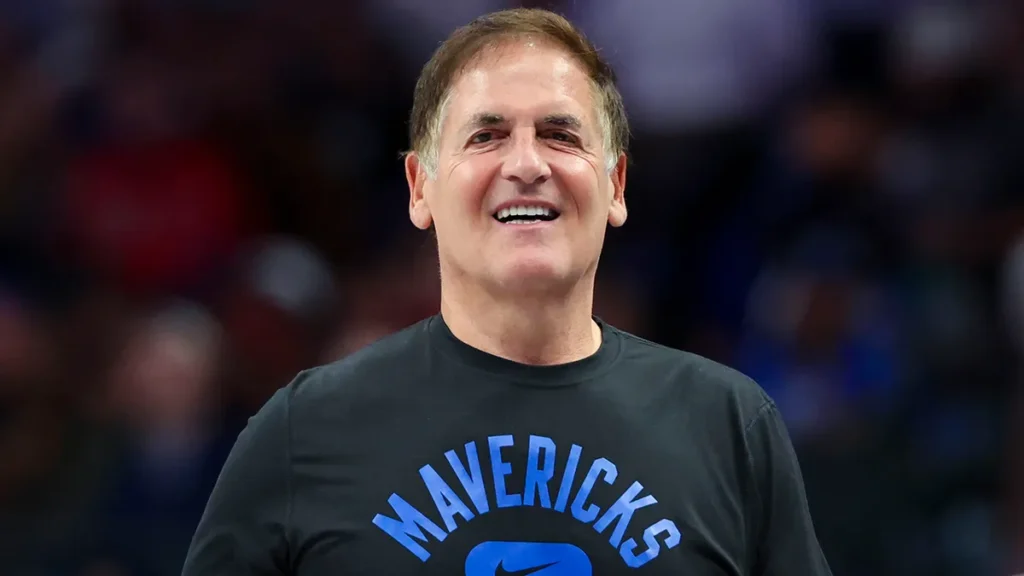
When I sat down with Dallas Mavericks owner Mark Cuban back in late 2017 for Scoop B Radio, the world was in a vastly different place. We were just beginning to wrap our heads around the potential of virtual reality, and “AI” was still largely a buzzword reserved for Silicon Valley pitch decks and sci-fi movies. But Cuban, a man who has made a career out of cashing in on the “next big thing” long before the crowd arrives, saw something else. He saw a second, more powerful wave of the dot-com boom—one built not on websites, but on the invisible architecture of data.
Looking back at that conversation now, in December 2025, it’s clear that Cuban wasn’t just guessing; he was blueprinting the future we are currently living in. The “Brave New World” he teased has officially arrived, and it has fundamentally reshaped everything from how we treat the human body to how we evaluate the game of basketball.
The Prophet of the “Second Boom”
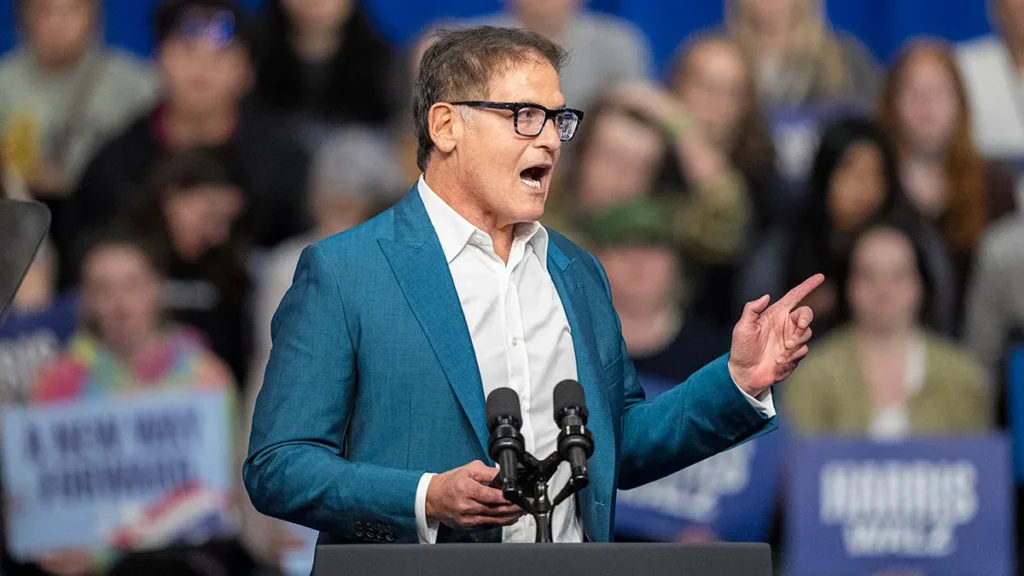
In 2017, Cuban gave me a definitive list of the technologies that would define this new era. “There’s a couple different things,” he said. “There’s deep learning, machine learning, there’s machine vision, bio-analytics, biomechanics, and virtual reality to a lesser extent.”
At the time, the comparison to the 90s dot-com explosion felt ambitious. The 90s gave us the internet, email, and the foundation of global e-commerce. How could “analytics” possibly match that? Cuban’s answer was rooted in the idea of efficiency and the “least path of resistance.” He knew that as technology became “tinier” and computer capacity became “faster,” the ability to intelligently sort through data and spit out actionable insights would become the world’s most valuable commodity.
By 2025, that prediction has become a global standard. We have transitioned from the “Internet of Things” to the “Intelligence of Everything.” The same machine vision Cuban discussed in 2017 is now the engine behind every NBA broadcast, every medical diagnosis at his Cost Plus Drugs company, and every autonomous logistics network moving goods across the country.
The New Architecture: A Championship Roster of Tech
To understand the scale of what Cuban saw, you have to look at the “talent density” of the technology currently dominating 2025. It isn’t just one “app” or one “gadget”; it’s a full roster of specialized intelligences working in tandem.
The landscape of sports technology has evolved into a powerhouse of specialized roles, much like a championship roster. At the forefront are the MVPs, Generative AI models that have graduated from simple data sorting to actually “thinking” and “creating” alongside us, providing strategic insights that feel almost human. Backing them up are the Snipers of Machine Vision; these systems are now utilized by every professional team through the NBA Inside the Game platform, tracking 29 specific data points per player at a staggering rate of 25 times per second, offering surgical precision in performance analysis.
Finally, acting as the Defensive Anchors, injury prediction algorithms serve as a silent safety net, flagging high-risk indicators like potential Achilles strains weeks before a player even feels a tweak, fundamentally changing the way we manage athlete longevity.
This shift from reactive to predictive medicine is exactly what Cuban alluded to when he spoke about bio-analytics. We are no longer guessing why an athlete’s shot is flat or why a hamstring keeps tightening up; the data—driven by those 29 tracking points—tells us the story before the first symptom even appears.
Beyond the Hardwood: AI as the New Literacy

While the sports world has been the most visible testing ground for these ideas, Cuban’s vision for 2025 extends far into the workforce and education. In 2017, he warned that we “all were born too soon” because the coming tech leap would be so profound. Now that we are in the thick of it, he has shifted his message from observation to urgency.
Cuban has spent much of 2025 advocating for what he calls “AI fluency.” Just as he used to argue that every kid needed to understand the internet in the late 90s, he now argues that understanding how to “prompt” and “collaborate” with AI is the new baseline for employment.
“You’re not going to lose your job to an AI,” Cuban famously noted earlier this year, “but you’re going to lose your job to someone who uses AI.”
He has taken this philosophy to the streets, partnering with initiatives like Samsung’s Solve for Tomorrow to bring AI boot camps and resources to schools that lack access. For Cuban, the “Second Boom” isn’t just a way for billionaires to get richer; it’s a tool that can democratize brilliance. If a kid in an underserved neighborhood has access to a large language model and knows how to use it, they have the same research capacity as a Ph.D. at an Ivy League university.
The Pivot from Social to Algorithmic
One of the most striking changes between our 2017 talk and today is how we consume media. Back then, “Social Media” was the king. We followed people, we shared posts, and we lived in a digital community. But as Cuban pointed out in several 2025 interviews, we have moved from “social” to “algorithmic.”
The platforms we use today don’t care who you follow as much as they care what the AI knows you like. This is the “Machine Vision” and “Deep Learning” Cuban discussed with me years ago, finally reaching its final form. It has turned every user experience into a hyper-personalized ecosystem. Whether you’re watching a Mavs game with AI-powered data overlays tailored to your betting profile, or you’re getting a personalized health plan from Cost Plus Drugs, the experience is unique to you.
“We All Were Born Too Soon”
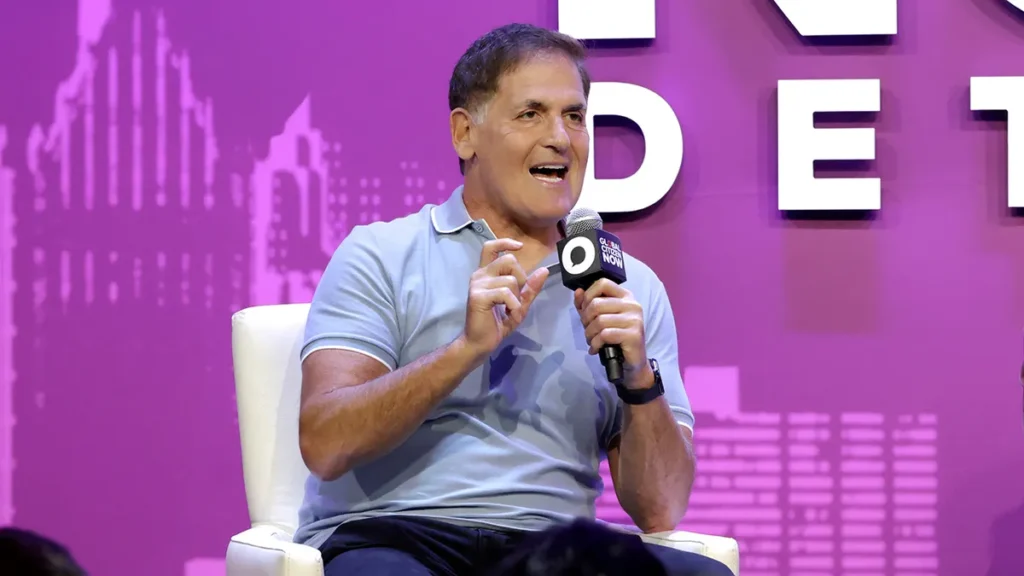
There’s a certain irony in Cuban’s 2017 quote: “Technology is just getting so much tinier and computer capacity so much faster… that we all were born too soon. It’s going to be crazy 20 years from now.”
As we stand here in 2025, we are nearly halfway to that 20-year mark, and the “crazy” has already begun. We are seeing things like NBA Inside the Game quantify “Gravity”—the invisible pull a player like Steph Curry has on a defense—through neural networks that process 60 frames of optical tracking data every second. We are seeing AI reduce non-contact injuries by over 60% in elite soccer and basketball programs.
But for Cuban, the excitement isn’t just about the stats on the screen. It’s about the fact that we are finally closing the gap between human intention and machine execution. The “least path of resistance” he talked about on my show has finally been paved.
The Final Scoop: A Legacy of Anticipation
Mark Cuban’s insights from 2017 serve as more than just a successful prediction; they serve as a masterclass in anticipation. He didn’t just survive the first dot-com boom; he studied its DNA so he could recognize the second one when it arrived in the form of a line of code.
Whether he is disrupting the pharmaceutical industry by cutting out middlemen or reinventing how we watch basketball through AWS-powered analytics, Cuban’s core philosophy remains the same: the tools change, but the advantage always goes to those who take the time to learn them.
The “Second Boom” is no longer a forecast. It is the air we breathe in 2025. And as always, the person sitting courtside, watching the data flow in real-time, is the same man who told us exactly what was going to happen eight years ago. Mark Cuban wasn’t just right about the technology; he was right about the opportunity. The question is, now that the boom is here, who is going to have the “AI fluency” to lead the next one?